Monday, July 12, 2010

Meeting of the Western Union


Fifty members of Western Union, an organization of Western fiction and movie buffs in Japan, met at the Chuck Wagon restaurant in Shibuya Ward, Tokyo, on Saturday, July 10, 2010. It was the 10th meeting of the group, which was formed three years ago, in the wake of another organization (which I don't remember the name of). The "meeting" went on for three hours over TexMex food and pitchers of beer. Above is the commemorative picture of the bunch. I'm somewhere in the back in a brown straw hat.


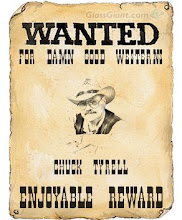
Chuck Tyrell was a guest speaker. Black Horse Westerns in general and Guns of Ponderosa in particular received a rounding recommendation from Tyrell. Several of the members wanted specific information on how to purchase BHW, which I provided. I mentioned Amazon around the world and suggested The Book Depository.


Duke Hiroi is Western Union's gun expert. His amazing knowledge of guns of the west puts me to shame and would be a lesson to all writers of western fiction. I'll have more to say about Duke as we learn what kinds of model guns are available for the Western fan in Japan.

Remington New Model Army model gun


In Japan, people are not allowed to own or carry handguns (except the police and the gangsters, of course) so a model gun industry has grown up to serve the men and women who like the feel of a gun in their hands.

I was at a meeting of the Western Union (more to come later) on Saturday, where friend Duke Hiroi showed me an article he'd written in COMBAT magazine. It was a review of a new model from Craft Apple Works, a replica of the 1858 Remington New Model Army six shooter.

Duke had high praise for the authenticity of the model. This CAW Remington is of cast zinc alloy, except for the brass trigger guard and certain internal parts that are milled steel. As a result, the weight is somewhat lighter than the real thing. However, weights and special cylinders can be ordered to put the model's weight at about 2.2 pounds.

The Remington New Model Army was a popular gun in the cap-and-ball era. It had a top strap to the frame that held the barrel firmly. Cylinders could be pre-loaded with paper cartridges and minie-ball-like conical bullets and four or five carried on the person. After six shots, the cylinder could be quickly and easily changed for another six rounds. The Colt dragoon and 1861 army and navy pistols had no top strap, which made replacing the cylinders a time-consuming job. Colt's six-shooters didn't come with a top strap until the Colt SAA Frontier and Peacemaker models came out.

I'm sure we'll hear more from Duke as time goes on.

Friday, July 9, 2010

Woman marshal in the Gateway to the West


Saint Louis, Missouri, calls itself the Gateway to the West. In the late 1880s, the city was beset by a ring of counterfeiters. But an intrepid U.S. Marshal put an end to their activities -- U.S. Marshal Phoebe W. Couzins. And it was not the first time she had led her deputies in the pursuit and capture of criminals who broke federal law.

Phoebe was made a deputy marshal by her father, U.S. Marshal J.E.D. Couzins, in 1887. She was the first. Couzins was confident Phoebe could do the job because she'd already racked up a list of firsts. She was the first woman graduate of Washington University Law School in Saint Louis. She was the first woman to pass the Missouri bar exam. She was also the first professional woman lawyer in the United States. Becoming a U.S. Marshal by President Grover Cleveland merely added another first for Phoebe.

She was a well-known campaigner for women's rights, but died in 1913, seven years before the 19th amendment gave national suffrage to women. Rumor says she asked that her U.S. Marshal's badge be buried with her.

(From the files of the now-defunct National Association for Outlaw and Lawman History)
(Photo from www.picturehistory.com)

Saturday, July 3, 2010

How profitable was it to rob Wells Fargo?

In January 1885, J.B. Hume, chief of the Wells Fargo detective force filed a prepared statement on losses and casualties suffered by the company from 1870 to 1884.

The amount taken from Wells Fargo express shipments by stage robbers, train robbers, and burglars during those years totaled $415,312.

Rewards paid for the apprehension and arrest of the "bad guys", including a percentage of any money recovered, totaled $73,541.

Attorneys' fees paid for assisting in the prosecution of those apprehended came to $22,367.

Other "incidental" expenses incurred in connection with the robberies was $90,000.

Salaries of guards and special officers during these years totaled $326,517.

Thus, the total loss and costs for the fourteen years in question was slightly more than $927,700.

(From the files of the now-defunct National Association for Outlaw and Lawman History)

Friday, July 2, 2010

Little-known facts about outlaws

How did Ella Watson hit the front page of the newspapers?

Better known as Cattle Kate, Watson was hanged on the Sweetwater for supposedly disposing of stolen cattle.

What famous Indian scout, plainsman, Pinkerton man, and Rough Rider was handed in Cheyenne for murder?

Tom Horn. He was hanged November 20, 1903, for allegedly murdering William Nickell, a young boy.

Who was uncle to the Ford boys, guerrilla raider with the Jameses during the Civil War, and later a gang member?

Jim Cummings, also known as "Windy Jim," the last of the raiders to die, in 1929, at Higgensville, Missouri.

When and where was Nathan D. Champion, who was slain in Wyoming during the Johnson County War, born?

September 29, 1857, near Round Rock, Texas.

Who was the man known in Texas as Billy Leroy?

Billy Leroy was William Henry Harrison Bonney, Jr., otherwise known as Billy the Kid.

How did Pat Garrett, the man who shot Billy the Kid, die?

He was killed from ambush by Jim Miller, but Wayne Brazel took the blame. The dastardly deed took place February 28, 1908. Brazel was acquitted and dropped out of sight.

How many men did J. Pinckney "Pinky" Higgins kill and what happened to him?

Higgins led a faction in the Horrell-Higgins feud. He killed 19 men. He died of a heart attack in 1893.

A well-known bandit, sometimes known as Buck, was tried for train robbery in Missouri and for murder in Alabama, and was acquitted both times. What was his real name?

Alexander Franklin "Frank" James, brother to Jesse.

Who was the famous gunman who rode through Old Mobeetie, Texas, in his birthday suit?

Robert Clay Allison

(From the files of the now-defunct National Association for Outlaw and Lawman History)

Thursday, June 10, 2010

Review of The Killing Trail

Ron Scheel has reviewed The Killing Trail. See details here.

Thursday, June 3, 2010

The Killing Trail


Robert Hale Ltd. informs me that The Killing Trail, my sixth Black Horse Western, will be published on June 30, 2010.

The Dylan brothers ride high in Ouray, Colorado, until they bully a drifter who leaves three of them dead in the street. Nat Dylan, the youngest, swears to hunt down the drifter, Jared Carter, and avenge his brothers. Carter’s trail leads into Arizona country where Dylan meets Wagonwheel owner Colonel Alton Jackson and hires on to kill Jared Carter. But the more he learns of Carter and Jackson, the more he finds himself on the wrong side. He meets Carmen Vasquez, who sees him as an honorable man, and he feels the mutual attraction. Still, on his honor he must call out Jared Carter, but can he survive a gunfight with the man who killed three Dylans by himself?

I think it's a good read. Anyone want to review it?

CTW