Thursday, April 22, 2010

New Chuck Tyrell western out in August


The Dylan brothers ride high in Ouray, Colorado, until they bully a drifter who leaves three of them dead in the street. Nat Dylan, the youngest, swears to hunt down the drifter, Jared Carter, and avenge his brothers. Carter’s trail leads into Arizona country where Dylan meets Wagonwheel owner Colonel Alton Jackson and hires on to kill Jared Carter. But the more he learns of Carter and Jackson, the more he finds himself on the wrong side. He meets Carmen Vasquez, who sees him as an honorable man, and he feels the mutual attraction. Still, on his honor he must call out Jared Carter, but can he survive a gunfight with the man who killed three Dylans by himself?

The Killing Trail, a Black Horse Western by Chuck Tyrell, can now be pre-ordered from Amazon UK.

Wednesday, April 14, 2010

Butch Cassidy’s Girlfriend


For many years, John Stewart was the secretary of the National Association for Outlaw and Lawman History, an association that is now defunct. He lived in Logan, Utah, where he was a professor of English at Utah State University. He wrote of meeting Josie Bassett Morris, who was a girlfriend of Butch Cassidy (Robert LeRoy Parker) and other outlaws of that era.

Stewart made a special trip to Diamond Mountain, a high plateau near Flaming Gorge, located midway between Vernal, Utah, and Brown’s Hole, a famous outlaw hideout.

According to Stewart, Josie lived in a lonely cabin far from the nearest ranch. Steward knocked on the cabin door, but there was no answer. He was about to leave when he noticed a silver-haired lady coming toward him, a rifle held in the crook of her arm.

Rumor had it that Josie had offed several husbands and disliked men in general, so Stewart was somewhat concerned to see her toting a rifle. She turned out to be warm and hospitable, and promptly invited Stewart into her one-room abode. To explain why she carried the rifle, Josie claimed to have been after a mountain lion that was bothering her cows.

Some said she was a rustler. Stewart chose to believe her mountain lion story. Stewart inventoried her furniture as a bed, a stove, a table and two chairs. The floor was a flat slab of native stone upon which Josie had built the cabin herself, she said.

Josie was born in the early 1870s, which put her in her 80s when Stewart visited – eighty, yet out hunting mountain lions! Or maybe rustling cattle.


The Bassett family lived in Brown’s Hole, where Josie was born, and she and her younger sister Ann were well acquainted with Butch, Sundance, Matt Warner, Elza Lay, Tom Horn, Isom Dart (the Outlaw Mail), and Speck Williams.

Minnie Crouse Rasmussen, a Brown’s Hole pioneer and friend to outlaws, believed the rumors that Josie was a rustler and a husband-killer. Minnie claimed to “know for certain” that Josie poisoned one of her husbands. Stewart, however, wrote that he was “well impressed with her and find it impossible to believe that she was a husband killer or a cattle rustler.” He goes on to say that if she did any of those things, it was for “good reason.”

Stewart signed off his account with “To me, on that lovely spring morning atop Diamond Mountain, Josie Bassett Morris seemed a beautiful. Gracious, queenly woman who had survived a difficult life in the rugged Old West, and who in her old age was still fiercely independent – a trait I particularly admire.”

Friday, April 9, 2010

The Mason County War

Range wars are part and parcel of the west. So why is an Arizona boy interested in the Mason County War (also called the Hoodoo War), which took place in Texas?

Easy.


That’s where we first learn of Johnny Ringo.

Both sides in the war thought they were in the right. And throughout the fighting, no one was ever arrested. Dan Roberts, who led Texas Ranger Company D, said of the feud: “The reason that no arrests were made can only rest on hypothesis, and that is: the men supporting civil authority, needed no arrest, and those opposing it, urged equal claims of being right, but would not submit their grievances to law.”

According to historian Dave Johnson, the origins of the war were diverse and obscure . . . but the primary cause was greed over cattle. This was exacerbated by the friction between German immigrants and “American” residents of the county.

The Germans (18% of the population was “foreign born” in 1870), for the most part, had been loyal to the Union during the Civil War, and thus escaped much of the carpetbagging reconstruction tyranny of Governor E.J. Davis’s administration. This alone caused animosity.

The blood feud that backgrounds the Mason County War began with the shooting deaths of Tim Williamson on May 13, 1875, and Moses Baird on September 7, 1875.

And the death count kept climbing.


An young (20 years old) ex-Texas Ranger named Scott Cooley was the adopted son of Tim Williamson. Several men joined Cooley in his feud, including Johnny Ringo, as he tried to avenge his adoptive father.

In the 12-month period between February 1875 and January 1876, eleven men died in the Hoodoo War.

As the killing proceeded, Cooley and Ringo were arrested for threatening Sheriffs John Clymer and J.J. Strickland. They moved from county jail to county jail until a gang of cohorts broke them out of the Lampasas County jail in February.

Cooley soon died of brain fever (nothing to do with incarceration) and Johnny Ringo rode for Tombstone.

Read up about the Mason County War here.

Monday, March 29, 2010

Sharps, Remington & Winchester -- rifles that won the West


The Pedersoli Sharps rifle. Sharps was the quintessential buffalo gun. Christian Sharps's first breech-loading rifle came out in the late 1840s. The British government kept him in business with an order for several thousands of the rifle in the 1850s. By this time, the rifle was a favorite in the west as well. Civil War sharpshooters preferred Sharps weapons, mainly model 1859. America's buffalo herds rued the day the big Sharps .50 was produced, for it, along with the Remington rolling block rifle, was the main cause of the animal's near extinction. Sharps Big Fifty was accurate to at least 1,000 yards.


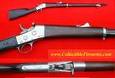
Remington rolling block rifles, although single-shot breechloaders, became one of the most popular rifles in the westward movement. They were also used abroad by the armed forces of Denmark, Sweden, Spain, Mexico, Egypt, and others. Of course the U.S. Navy, Army, and several state militias used the rifles as well. The Remingtons were simple, reliable, and came in several calibers. One famous story about Remingtons is the cattle drive from Texas to Montana, ramrodded by Nelson Story. Somewhere between Fort Laramie and Fort Reno, a band of Sioux ran off some of the cattle. Story had a case of Remington rolling block, which were among the first in the West at the time. He broke the guns out, distributed them to the drovers, and set out to get his beef back. The Indians stopped at what they felt was a safe distance and butchered one of the cattle. Story found them there, outgunned them with the Remingtons, and retrieved all his cattle but the butchered one.


The first famous Winchester repeating rifle was the Yellow Boy, model 1866, with a bronze gunmetal receiver. It used .44-40 rimfire cartridges.

To back up for a minute, the first sort-of cartridge was patented by Walter Hunt in 1848. It consisted of a conical lead ball filled with powder and sealed with a primer disk. The ammunition was produced in Norwich, Connecticutt by Horace Smith and Daniel Wesson (Smith & Wesson), but the Volcanic ammunition didn't catch on.

Volcanic Repeating Arms Co. was founded in 1855. One of its investors was Oliver Winchester. Two years later, the company failed, and Winchester took over, taking the Volcanic patents to the New Haven Arms Co. New Haven produced the Henry repeater in 1860, which fired a .44 caliber rimfire cartridge. This is the gun that the Southerners said could be loaded on Sunday and fired the rest of the week.

The first Winchester came after the company changed its name to Winchester Repeating Arms Co., the famed Yellow Boy model 1866, which also used rimfire .44 cartridges.


The next big innovation came in 1873. Winchester model 1873, most often just called Winchester '73, starred in the movie of the same name, along with co-star James Stewart. All the guns were factory fired, and the most accurate were inscribed with One in a Thousand on the receiver. They would cost $100 where the run-of-the-mill '73 could be had for $20. But some thought the price well worth it. One in a Hundred Winchester '73 rifles sold for $40.

With the 1873 Winchester came the centerfire cartridge in .44-40. The final tally shows that 720,610 Model 1873 Winchesters were made and sold.

Sunday, March 28, 2010

The Making of Guns of Ponderosa -- Part XI Final


The hired gunslinger is nothing new in a western story. In Shane, Jack Palance nearly upstaged Alan Ladd as he played gunman Jack Wilson, one of the original men in black.
We saw the same kind of hired gunslinger in Crossfire Trail, too. And then John Wayne faced a bevy of professional gunmen in The Shootist.
I liked the way the late Robert B. Parker handled the professional gunmen in his novel Appaloosa and how Ed Harris did it in the film of the same name. Specifically, that guns for hire were known amongst those on both sides of the law, and that there was a kind of unwritten law between them that whatever shooting was to be done would not be from ambush or in the dark of night, but on mutually agreed killing fields and at a mutually agreed time. Virgil Cole and Everett Hitch faced two gunmen, Matt Stryker, Tom Hall, and young Dan Brady faced three. Tom, however, was not in the initial gunfight. To find out how the final face-off turned out, you'll have to read the book.
And that's how Guns of Ponderosa was made.

Saturday, March 27, 2010

The Making of Guns of Ponderosa -- Part X


Richard Wheeler wrote a western novel entitled Drum's Ring. The heroine, Angie Drum, is a frontier woman who took over her husband's newspaper after his death. She uses the paper to expose graft and corruption in the town, including that of her own son, the mayor.

My Prudence Comstock is a young Angie Drum. She has found her niche in the newspaper business, and loves writing scorching pieces about the town, from her viewpoint. In reporting happenings, she also climbs on the soap box to preach to her readers about the kind of town she believes Ponderosa can be.

Although Prudence did not come to the same end as Angie, she did come very close.

Women in the west were no pansies. Take Lee Whipple-Haslam, for example. (notice the last name, lol). She was hired by Wells Fargo to ride a frequently robbed stagecoach. She was to provide detailed descriptions of the robbers. That she did. Height. Size. Clothing. Blood seeping through one man's glove. Cataract in another man's eye. Lee's testimony convicted the robbers. Lee was a typical westerner. She wanted revenge, was very aware of class distinctions, hated Chinese, and was all in favor of linchings. Information about Lee and other women in the west can be found in So Much to Be Done, a book edited by Ruth B. Moynhan, Susan Armitage, and Christiane Fischer Dichamp. You can find the book here.